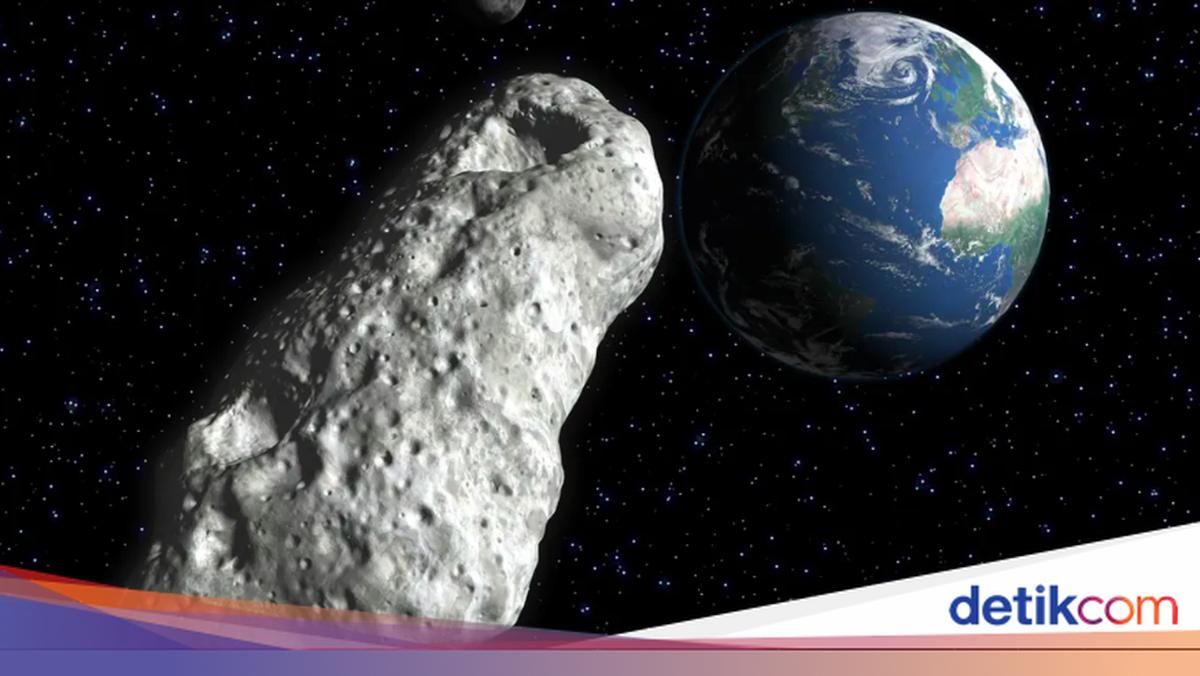
A small asteroid designated 2026 QQ8 has been captured by Earth's gravity and is currently circling the planet as a temporary mini-moon, according to detikInet. The roughly one-meter-wide object slipped into Earth's gravitational influence in late April 2026, but astronomers did not spot it until August.
The discovery is credited to Hungarian astronomer Krisztián Sárneczky, who found the object on 20 August 2026 using a telescope at the Piszkéstető Observatory in Hungary, detikInet reports. On 29 October 2026, the Minor Planet Center (MPC) announced that orbital calculations confirmed the object is temporarily bound to Earth.
Why it matters
Mini-moons are natural laboratories for scientists. Because these objects come relatively close to Earth, researchers can study the physical characteristics and origins of near-Earth asteroids without mounting a dedicated space mission. Each confirmed capture adds to a small but growing catalog of known temporary satellites, which helps astronomers refine models of how small bodies interact with planets.
The case also highlights how quickly the scientific picture can change. For a time, astronomers could not rule out that 2026 QQ8 was human-made debris — a spent rocket segment or similar hardware — rather than a natural space rock. Distinguishing between the two is not trivial at a distance, and the resolution of that question depended on follow-up work with larger instruments.
From suspected space junk to confirmed asteroid
To settle the object's origin, astronomers turned to more powerful telescopes in Hawaii and Arizona and examined how sunlight pressure affected its motion, according to detikInet. Solar radiation pressure is a slight push exerted by sunlight that can nudge the trajectories of small objects in space, making it a useful diagnostic for identifying artificial hardware.
The MPC concluded that the object is not human-made, stating that no link to any known artificial object was found, detikInet reports. That finding places 2026 QQ8 in the natural category — most likely a small asteroid that happened to pass close enough to Earth to be caught.
Its size means there is no cause for concern. At about one meter across, the object poses no meaningful threat; should it ever enter Earth's atmosphere, it would be expected to burn up and produce a bright fireball.
A messy orbit, and a schedule for departure
Unlike the Moon, which has circled Earth for billions of years, 2026 QQ8 is only a short-term companion. detikInet reports that the asteroid is expected to remain under Earth's gravitational influence until December 2026, after which it will break free and resume its own path around the Sun in 2027.
Its route is not a tidy circle. The asteroid follows an irregular trajectory as it moves around both Earth and the Moon before eventually heading back out into interplanetary space.
Perhaps counterintuitively, 2026 QQ8 never comes especially close to us. Its closest orbital approach is estimated at roughly 570,000 kilometers — about 1.5 times the average Earth-Moon distance, according to detikInet.
This is also not the object's first brush with our planet. Orbital reconstructions indicate it passed near Earth in 1965 and is expected to do so again in 2058, though neither of those encounters resulted in gravitational capture.
Not the first, and not the same as a quasi-moon
Earth has hosted temporary companions before. detikInet notes that asteroids 2020 CD3 and 2024 PT5 both spent time near the planet in recent years.
Astronomers draw a distinction between a mini-moon and a quasi-moon. A mini-moon is genuinely captured by a planet's gravity and orbits it for a limited period. A quasi-moon, by contrast, actually orbits the Sun on a path that makes it appear to travel alongside Earth. 2026 QQ8 belongs to the first group, since it is truly under Earth's gravitational sway.
For now, the object remains available for study, and its confirmed natural status means observations can focus on what it is rather than what it might have been. Watch for the MPC and follow-up observers to publish refined orbital data as 2026 QQ8 approaches its December departure.